

Transition Leader Howard Lutnick Explains President Trump Economic Policy, Tariffs and Energy Inflation
Jumpin’ ju-ju bones, I think we may have found Wilbur Ross’s replacement. In this segment on CNBC Trump transition team leader Howard Lutnick, explains simple MAGAnomics to the panel. Make this guy both Commerce Secretary and Chairman of the National Economic Council in 2025!
Starting with an explanation of his role within the Trump 2025 transition team, Lutnick then walks through the MAGAnomic principles enmeshed in President Trump’s economic policies. Mr. Lutnick begins the policy part by outlining how energy restrictions are driving inflation through higher costs of goods. Yes. Yes and Yes.
Then Lutnick shifts to talking about tariffs and is one of the only advisors outside the 2017 team (Robert Lighthizer, Wilbur Ross) who factually references ending the insufferable “Marshal Plan.” Again, yes, yes and YES.
Howard Lutnick gets it. The essential core of MAGAnomics. Drive down the cost of goods through expanded energy development, then leverage reciprocity in tariffs to end the exfiltration of wealth. Then cut out regulation and unleash American enterprise. This is the way to reverse this insufferable economic trajectory that creates a “service driven economy.” The entire interview is well worth watching:
.
A bonus video below.
One video with two minutes of Kamala Harris and Donald Trump both answering the same question. Listen to both sets of answers and it is clear who factually understands what needs to be done, and who is totally clueless.

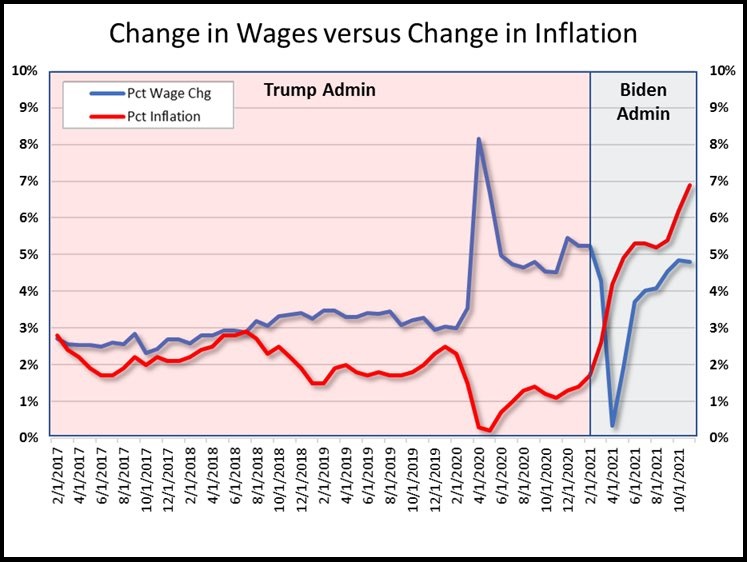
President Trump economic policy -vs- Joe Biden economic policy
When wages (blue line) are above inflation (red line) our income is growing, life is good and the working class has more disposable income to enjoy life. However, when wages (blue line) are lower than inflation (red line) our income is shrinking, life is a struggle and the working class has less disposable income to enjoy life.
♦ Point One – Nothing happens accidentally. The road to a “service-driven economy” is paved with a great disparity between financial classes. The wealth gap is directly related to the inability of the middle class to thrive.
♦ Point Two – There is nothing of value behind the obtuse term “service-driven economy.” The multinationals are paying for this administration, just like they paid the Obama administration; paying for economic policy that advances their interests. Congress goes along with the K-Street demands, because Wall Street is now the primary benefactor of legislative intent. Nothing about their effort is done with American interests in mind.
To go deep, keep reading.
♦ Point Three – Traditional Fascism was defined as an authoritarian government working hand-in-glove with corporations to achieve totalitarian objectives. A centralized autocratic government headed by a dictatorial leader, using severe economic and social regimentation, and forcible suppression of opposition.
That governmental system didn’t work in the long-term because the underlying principles driving free people rejected government authoritarianism. Fascist governments collapsed, and the corporate beneficiaries were nulled and scorned. Then along came a new approach to achieve the same objective.
The World Economic Forum (WEF) was created to use the same fundamental associations of government and corporations. Only this time the corporations organized to tell the governments what to do. The WEF was organized for multinational corporations to assemble and tell the various governments how to cooperate to achieve control.
Fascism is still the underlying premise, the WEF just flipped the internal dynamic.
The assembly of the massive multinational corporations, banks and finance offices now summon the government leaders to come to their assembly and receive their instructions. Some have called this corporatism. However, the relationship between government and multinationals is just fascism essentially reversed with the government doing what the corporations tell them to do.
…A massive multinational corporate conglomerate; telling a centralized autocratic government leader what to do; and using severe economic and social regimentation as a control mechanism; combined with forcible suppression of opposition by both the corporations and government.
Then we broke the glass, hit the emergency button and called Batman.

♦ Point Four – Donald J Trump was/is a walking red-pill; a “touchstone”: a visible, empirical test or criterion for determining the quality or genuineness of anything political. I have been deep enough into the network of the Deep State to understand the scale and scope of this enemy. To think that President Trump alone could carry the burden of correcting four decades of severe corruption of all things political, without simultaneously considering the scale of the financial opposition, is naive in the extreme.
POTUS Trump was disrupting the global order of things in order to protect and preserve the shrinking interests of the U.S. He was fighting, almost single-handed, at the threshold of the abyss. Our American interests, our MAGAnomic position, was/is essentially zero-sum. His DC and Wall-Street aligned opposition (writ large) needed to repel and retain the status-quo. They desperately wanted him removed so they could return to full economic control over the U.S, because it is the foundation of their power.
Without Donald J. Trump, these entities would still be operating in the shadows. With Donald J. Trump, we can clearly see who the real enemy is.
In these economic endeavors President Trump was disrupting decades of financial schemes established to use the U.S. as a host for their endeavors. President Trump was confronting multinational corporations and the global constructs of economic systems that were put in place to the detriment of the host (USA) ie YOU. There are trillions at stake; it is all about the economics; everything else is chaff and countermeasures.
In most of the modern post-war industrial era (1950-1980), banking was a boring job and only slide rule bean counters and actuarial accountants moved into that sector of the workforce. Most people don’t like math – these were not exciting jobs. Inside the most boring division of a boring banking industry were the bond departments within the larger bank and finance companies.
The excitement was in the actual economy of Main Street business. The giants of industry created businesses, built things, manufactured products, created innovation and originated internal domestic wealth in a fast-paced real economy. Natural peaks and economic valleys, as the GDP expanded and contracted, based on internal economic factors of labor, energy, monetary policy and regulation.
Main Street generated the pool of political candidates, because the legislative conduct of politicians had more impact on Main Street. Simply, the business agents had a vested interest in political determinations.
Political candidates courted industrialists, business owners, and capitalist giants to support them. As a consequence, Main Street USA was in control of DC outcomes.
Despite the liberal talking points to the contrary, this relationship was a natural synergy of business interests and political influence. It just made sense that way, and the grown-ups were generally in charge of it.
 ♦ Commercial banks courted businesses because bankers needed deposits. Without deposits banks could not generate loans; without loans banks could not generate profits…. and so it was. By rule, only 10 percent of a commercial bank’s income could stem from securities.
One exception to this 10% rule was that commercial banks could underwrite government-issued bonds. Investment banks (the bond division) were entirely separate entities. The Glass-Steagall banking laws of 1932 kept it that way.
However, mid 1970’s bank regulators began issuing Glass–Steagall interpretations -that were upheld by courts- and permitted banks and their affiliates to engage in an increasing variety and amount of securities activities. After years of continual erosion of the Glass-Steagall firewall, eventually it disappeared.
This became the origin of the slow-motion explosion of investment banking. If you look back historically from today toward 1980 (ish), what you will find is this is also the ultimate fork where economic globalism began overtaking economic nationalism.
Banks could now make money, much more money, from investment divisions issuing paper financial transactions, not necessarily dependent on actual physical assets. The transactions grew exponentially.
The bond market portion ultimately led to the ’07/’08 housing collapse, and derivative trading (collateralized debt obligations or CDO’s) generated trillions of paper dollars. Long before the ’08 collapse, business schools in 1980 began calling this the second economy (a false economy, or the invisible economy).
The second economy, which ultimately became the global economy, is also the Wall Street investment economy. Two divergent economies: Wall Street (paper), and Main Street (real).
There is no real property, real capital, real tangible assets in the Wall Street economy. The false economy is based on trades and financial transactions, essentially opinions. Paper shifts, and buys and sells based on predictions and bets (derivatives).
Ford Motor Company (only chosen as a commonly known entity) has a stock valuation based on their actual company performance in the market of manufacturing and consumer purchasing of their product. However, there can be thousands of financial instruments wagering on the actual outcome of their performance.
There are two initial bets on these outcomes that form the basis for Hedge fund activity. Bet ‘A’ that Ford hits a profit number, or bet ‘B’ that they don’t. There are financial instruments created to place each wager. [The wagers form the derivatives] But it doesn’t stop there.
Additionally, more financial products are created that bet on the outcomes of the A/B bets. A secondary financial product might find two sides betting on both A outcome and B outcome.
Party C bets the “A” bet is accurate, and party D bets against the A bet. Party E bets the “B” bet is accurate, and party F bets against the B. If it stopped there, we would only have six total participants. But it doesn’t stop there, it goes on and on and on…
The outcome of the bets forms the basis for the tenuous investment markets. The important part to understand is that the investment funds are not necessarily attached to the original company stock, they are now attached to the outcome of bet(s). Hence, an inherent disconnect is created.
Subsequently, if the actual stock doesn’t meet it’s expected P-n-L outcome (if the company actually doesn’t do well), and if the financial investment was betting against the outcome, the value of the investment actually goes up. The company performance and the investment bets on the outcome of that performance are two entirely different aspects of the stock market. [Hence two metrics.]
Insurance products create an even larger subdivision within the false economy as hedgers wagered on negative outcomes. The money wagered is exponential – some say more than a quadrillion currently floats.
♦ Now you realize, in hindsight, there had to be a point where the value of the second economy (Wall Street) surpassed the value of the first economy (Main Street). Investments, and the bets therein, needed to expand outside of the USA. Hence, globalist investing.
However, a second more consequential aspect happened simultaneously.

The politicians became more valuable to the Wall Street team than the Main Street team; and Wall Street had deeper pockets because their economy was now larger.
As a consequence, Wall Street started funding political candidates and asking for legislation that benefited their interests.
When Main Street was purchasing the legislative influence the outcomes were beneficial to Main Street, and by direct attachment those outcomes also benefited the average American inside the real economy.
When Wall Street began purchasing the legislative influence, the outcomes therein became beneficial to Wall Street. Those benefits are detached from improving the livelihoods of main street Americans because the benefits are “global” needs. Global financial interests, investment interests, are now the primary filter through which the DC legislative outcomes are considered.
Democrats want power; Republicans want money. Threaten Democrats power, they get vicious. Threaten Republicans money, they get vicious. Democrats use money to get power; Republicans use power to get money. The ideology of the democrats drives their donor activity. The donor activity drives the republican ideology.
This is the core and essential difference between both wings of the DC UniParty, two wings of the same vulture. This is the truth of the thing. Underline it, put it on Post-it notes, remind yourself of this baseline in all review of both parties. This is the core motive behind everything!

August 2026 July 2026 June 2026 May 2026 April 2026 March 2026 February 2026 January 2026 December 2025 November 2025 October 2025 September 2025 August 2025 July 2025 June 2025 May 2025 April 2025 March 2025 February 2025 January 2025 December 2024 November 2024 October 2024 September 2024 August 2024 July 2024 June 2024 May 2024 April 2024 March 2024 February 2024 January 2024 December 2023 November 2023 October 2023 September 2023 August 2023 July 2023 June 2023 May 2023 March 2023 January 2023 December 2022 November 2022 October 2022 September 2022 August 2022 July 2022 June 2022 May 2022 March 2022 February 2022 January 2022 December 2021 November 2021 October 2021 September 2021 August 2021 July 2021 June 2021 May 2021 April 2021 March 2021 February 2021 January 2021 December 2020 November 2020 October 2020 September 2020 August 2020 July 2020 June 2020 May 2020 April 2020 March 2020 February 2020 January 2020 December 2019 November 2019 October 2019 September 2019 August 2019 July 2019 June 2019 May 2019 April 2019 March 2019 February 2019 January 2019 December 2018 November 2018 October 2018 September 2018 August 2018 July 2018 June 2018 May 2018 April 2018 March 2018 February 2018 January 2018 December 2017 November 2017 October 2017 September 2017 August 2017 July 2017 June 2017 May 2017 April 2017 March 2017 February 2017 January 2017 December 2016 November 2016 October 2016 September 2016 August 2016 July 2016 April 2016 February 2016 January 2016 December 2015 November 2015 October 2015 July 2015 June 2015 May 2015 March 2015 January 2015 December 2014 November 2014 October 2014 September 2014 August 2014 July 2014 June 2014 May 2014 April 2014 March 2014 February 2014 January 2014 December 2013 November 2013 October 2013 September 2013 August 2013 July 2013 June 2013 May 2013 April 2013 March 2013 February 2013 January 2013 December 2012 November 2012 October 2012 September 2012 August 2012 July 2012 June 2012 May 2012 April 2012 March 2012 February 2012 January 2012 December 2011 November 2011 October 2011 September 2011 August 2011 July 2011 June 2011 May 2011 April 2011 March 2011 February 2011 January 2011 December 2010 November 2010 October 2010 September 2010 August 2010 July 2010 June 2010 May 2010 April 2010 March 2010 February 2010 January 2010 December 2009 November 2009 October 2009 September 2009 August 2009 July 2009 June 2009 May 2009 April 2009 March 2009 January 2009 December 2008 November 2008 October 2008 September 2008 August 2008 July 2008 June 2008 May 2008 April 2008 March 2008 February 2008 January 2008 December 2007 November 2007 October 2007 September 2007 July 2007 June 2007 May 2007 April 2007 March 2007 February 2007 January 2007 December 2006 November 2006 October 2006 September 2006 August 2006 July 2006 June 2006 May 2006 April 2006 March 2006 February 2006 January 2006 December 2005 November 2005 October 2005 September 2005 August 2005 July 2005 June 2005 May 2005 April 2005 March 2005 February 2005 January 2005 December 2004 November 2004 October 2004 September 2004 August 2004 July 2004 June 2004 May 2004


